Zaffarology explained: the 5 Pillars behind Zaffar Khan’s business method
20 NOVEMBER 2026 · 9 MIN READ · BY ZAFFAR KHAN
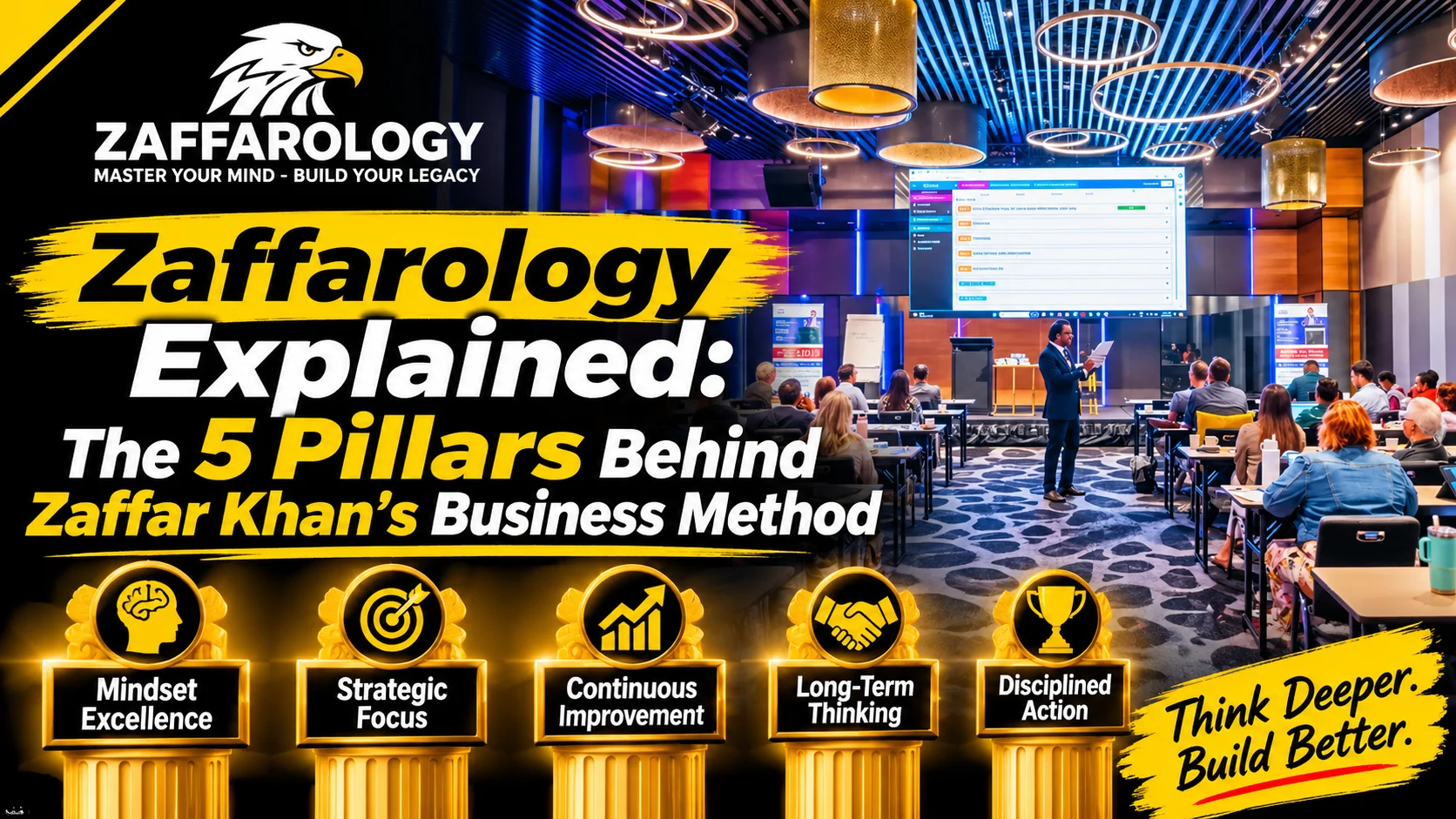
Most business owners do not lack ideas. They lack a dependable way to turn Monday's plan into Friday's result. Books, podcasts and seminars hand out plenty of inspiration, yet the week still fills up with phone calls, small fires and half-finished jobs. Zaffarology exists for that gap.
Zaffar Khan, an Australian business transformation specialist, built the method around one conviction: motivation, knowledge and meetings only matter when they end in action. This guide explains what Zaffarology is, where it came from, how each of the five pillars works day to day, and which owners get the most from it.
What Zaffarology means
Zaffarology is a practical business expansion system created by Zaffar Khan. The name sits on everything he teaches, from workshops and mentoring to his podcast and books. At its centre are five pillars, and each one is a habit or structure an owner can start using this week.
The aim is to move owners from overthinking to execution. The system gives them clearer goals, steadier accountability, smarter processes and progress they can measure. Nothing in it calls for special software or a consulting budget. A notepad, a team willing to talk for two minutes and a calendar are enough to begin.
Zaffar's tagline promises forty years of business success in three. Treat that as ambition rather than a guarantee. His own site carries an earnings and results disclaimer, and what you get out depends on what you put in. What the method does offer is compression. It takes lessons that normally arrive through decades of expensive trial and error and packages them into something you can practise for ninety days.
Who is behind it
Zaffar Khan describes himself as an entrepreneur, global speaker, mentor and author of more than 50 books, with about 40 years across several industries. His About page says he started out as a cleaner, taxi driver and labourer. He went on to build the largest government-accredited taxi training centre in Australia, then a home doctor service that grew into the second largest in the country. Later he started a disability services business which, by his account, reached 2,400 employees across 185 branches.
Those details explain why the pillars read like lessons from someone who has run large teams. Daily accountability, written processes and regular reviews are what keep hundreds of people pulling in one direction. Zaffar also talks openly about setbacks, and his belief that stagnation hurts more than loss shows up in the design. The method assumes you will miss some deadlines. It gives you a way to recover instead of a reason to quit.
The Painful Stories page makes the same argument with 200 examples. Abraham Lincoln, Thomas Edison and Oprah Winfrey all sit there, each one rejected, fired or broke before the success people remember.
The five pillars
Pillar 1: Dreaming to achieving
Goals begin in the head. Zaffar starts with how the brain works, because thoughts drive emotions, emotions drive actions and actions produce results. Once an owner sees that chain, the next job is to turn a loose dream into a goal with five parts: the exact target, the reason behind it, the action plan, the person responsible and the deadline.
Research supports the push for precision. Edwin Locke and Gary Latham spent 35 years studying goal setting. Their review of that work found that specific, difficult goals lead to higher performance than a general call to do your best. A goal like "grow the business" gives nobody anything to do on Tuesday. A goal with a number, a reason, an owner and a date does.
The mental side gets its own attention on the blog. The post on your will versus your imagination shows how Zaffar thinks about the gap between wanting something and acting on it.
Pillar 2: 2 minute huddle meetings
Most meetings fail because they run long and stay fuzzy. The huddle fixes both problems. Every task has an owner and a due date. The leader asks each owner about their task, and the answer takes one of two forms. "Yes" means the job is done. If it is not done, the owner gives the next due date and nothing more. No stories, no excuses.
Software teams adopted a similar habit long ago. The Scrum framework caps its daily meeting at 15 minutes so people stay on topic and spend the time exposing blockers instead of debating them, as the Scrum Alliance explains. Zaffar's version is tighter still, and the tightness is deliberate. Two minutes survives a frantic week. It also gives the team a daily moment where a missed task becomes visible instead of quietly sliding off the list.
Pillar 3: How to achieve
A goal and a willing team still need a route. This pillar says every project deserves a clear, step-by-step system. Break the work into manageable steps, draw a flowchart so the sequence is easy to see, and make sure each person knows their part.
The pillar also gives every project a pilot and a copilot. The pilot leads. The copilot supports, assists and takes over when the pilot is away or stuck. That setup removes a familiar weakness in small firms, where one person holds all the knowledge and a sick day halts the job. Written steps and a named backup also make training new staff far simpler, since the process lives on paper instead of in somebody's memory.
Pillar 4: AM planning and PM achievement
This pillar sets the daily rhythm. Each morning, before the day starts, you choose between one and five money-making actions. Each night you check whether they happened. Anything unfinished carries over to tomorrow. Run that loop for 90 days and it begins to compound. Workshop attendees often mention the early start that goes with it, with planning done around 5:00 am.
The phrase "money-making actions" does real work here. Owners tend to fill their days with tasks that feel urgent, such as inbox cleaning, admin and small design tweaks. A short morning list forces a decision about what actually moves revenue.
Psychologists call the underlying technique an implementation intention, which is a plan that fixes when and how you will act. A meta-analysis of 94 studies, summarised by the National Cancer Institute's research programme, found a medium-to-large effect on goal attainment. The AM and PM routine applies that idea once a day.
Pillar 5: Fortnightly progress review
Daily habits need a wider lens now and then. On the 1st and the 16th of each month, you review progress. Rank how people and projects performed, give feedback, assign responsibility and set fresh deadlines. If either date lands on a public holiday, move the review to the next day so the rhythm holds.
Three supports sit under the review. Loyalty builds trust inside the team. AI improves efficiency, for example by drafting reports or tracking tasks. Accurate record keeping means decisions rest on what happened instead of what people remember. Reviews twice a month come often enough to catch drift and rarely enough to leave room for real work.
How the pillars connect
Read in order, the pillars form a loop. Pillar 1 sets the target and Pillar 3 maps the route. Pillar 4 cuts the route into today's actions. Pillar 2 checks those actions out loud every day, and Pillar 5 steps back every two weeks to adjust the plan. Take one away and the loop leaks. Goals without huddles drift. Huddles without goals turn into status chatter.
One question runs through the whole system: who does this, and by when? Asking it consistently explains why the method scales from a solo operator to a company with hundreds of staff. The same question works in a two-person studio and in a head office.
Who gets the most from it
Owners of small and mid-sized firms stand to gain the most. The Australian Small Business and Family Enterprise Ombudsman reports that small businesses employ over 5 million people, roughly 42% of the private sector workforce. Many of those owners handle sales, operations and hiring at once, with no layer of managers to chase progress. A system that fits inside a morning list and a two-minute call suits that reality.
People about to start a business also benefit. One workshop attendee wrote that he came because he wanted to start a company and left knowing which questions to settle first. Managers whose teams hold plenty of meetings and produce little output form a third group. The huddle gives them a replacement.
The method suits some people less. Anyone who wants theory without practice will find it thin, and so will owners unwilling to answer to another person. Accountability sits at the core, and it only works when somebody is watching the ledger.
Ways to learn Zaffarology
The entry points run from free to intensive.
The quickest start is the free 5 Pillars Workbook, which walks through each pillar with space to write your own goals. Shorter lessons arrive through the Zaffarology podcast, recorded for owners who want something they can use the same day.
The one-evening workshop runs from 6:00 pm to 9:00 pm. Each session covers business matchmaking, the 40-years-in-3 idea and practical AI tools. The matchmaking part brings together people who hold capital and people who hold skills, with up to ten potential matches per event. Attendees can also put questions to Zaffar directly, a feature several past attendees singled out as the most useful part of the night.
Owners who want sustained accountability can apply for business expansion mentoring. The 90 Day Business Transformation Challenge pairs weekly mentoring calls with the daily AM and PM structure and an accountability scorecard.
For background on the mindset behind all of this, the blog post on achieving your potential is a short read, and the books page lists the longer ones.
Common questions
Is Zaffarology only for large companies? No. The pillars cost almost nothing to start, and a one-person business can run a huddle with a business partner, a mentor or an accountability buddy.
How long does it take to see a difference? The method is built around a 90-day cycle because the AM and PM rhythm needs repetition before it sticks. Results vary by owner and by business.
Do I need special tools? A notebook and a calendar cover the basics. Pillar 5 does encourage AI tools for efficiency, and the workshop teaches some practical ones.
What if I miss a deadline? The system expects it. Under Pillar 2 you state the next due date and move on, and under Pillar 4 you carry the task into tomorrow's list.
Where to begin
Pick one pillar and try it for a week. Tomorrow morning, write down between one and five actions that bring in money. Tonight, tick off the ones you finished and carry the rest forward. Then ask your team for a yes or a new date on each open task. The 5 Pillars workbook can guide the next step, and the full 5 Pillars overview lays out the rest of the system.
NEXT WORKSHOP · FRIDAY, 18 DECEMBER 2026
Achieve 40 years of business success in 3.
KEEP READING
More from the Journal

11 NOVEMBER 2026 · 4 MIN READ
Stop Overthinking, Start Executing: How Zaffarology Turns Business Goals Into Action

29 OCTOBER 2026 · 7 MIN READ
What Is Zaffarology? The Method, the Workshop and How to Get Started
Search for Zaffar Khan and one word keeps appearing: Zaffarology.

19 NOVEMBER 2026 · 6 MIN READ
Start the Year With a 90-Day Business Plan: Why January Is the Right Time to Begin
Plan a 90-day business sprint from January 2027. Learn how to use the new year fresh start, set review dates, count Queensland public holidays.